What Is a Job Fixer? How AI Fixes Your Resume in Minutes
Your resume isn't broken because you're unqualified — it's broken because it wasn't built for the way hiring works in 2026. A job fixer changes that fast, using AI to close the gap between where your resume is and where it needs to be.
What Is a Job Fixer? How AI Fixes Your Resume in Minutes
You've reread your resume a dozen times. You've tweaked the formatting, swapped out a few words, and still — silence. No callbacks. No interviews. Just the hollow sound of applications going nowhere.
Here's what most job seekers miss: the problem usually isn't what is on their resume. It's that the resume wasn't optimized for the two audiences that decide your fate — the ATS that ranks it and the recruiter who has six seconds to skim it. That's exactly the gap a job fixer closes.
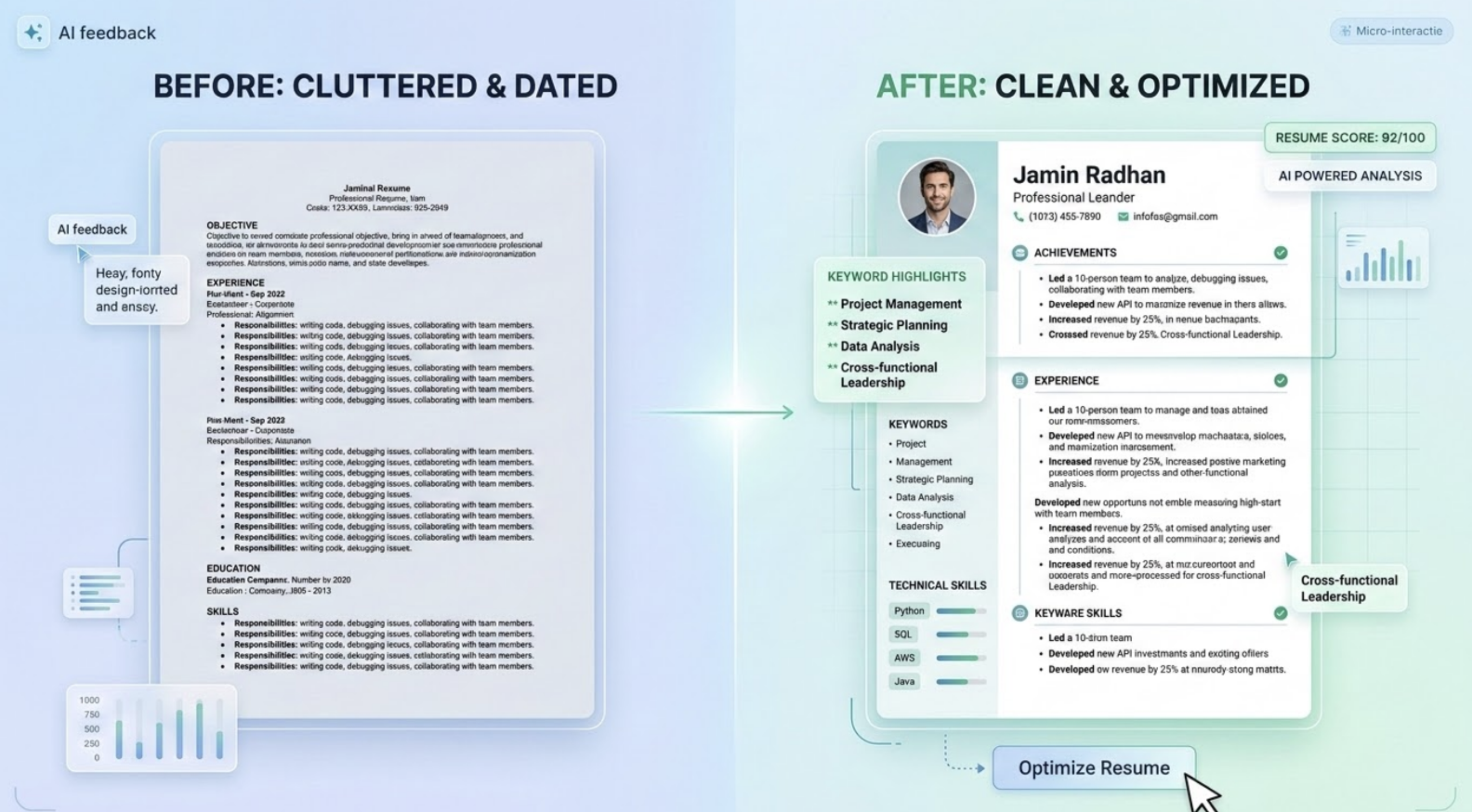
The direct answer: A job fixer is an AI-powered tool that analyzes your existing resume, identifies what's holding it back — weak language, missing keywords, formatting issues, poor alignment with the job description — and rewrites or scores it so it performs better. JobFix.ai's AI Fixer does this automatically: upload your resume, paste a job description, and get specific, actionable edits in under two minutes.
A study of 15,000 applications found that ATS-optimized resumes achieve an 11.7% callback rate, compared to just 4.2% for generic ones — nearly a 3× difference, driven entirely by the kind of targeted fixes an AI job fixer makes.
This post explains what a job fixer actually does, when to use one, and how to get the most out of the process without ending up with a resume that sounds like it was written by a robot.
Key Takeaways
- A job fixer diagnoses and rewrites your resume to match a specific role — it's targeted editing, not generic advice
- ATS-optimized resumes get 11.7% callback rates vs. 4.2% for generic versions (study of 15,000 applications)
- AI resume writing assistance increases hires by 7.8% in a randomized controlled trial of 480,948 job seekers (NBER WP 30886, 2023)
- The risk isn't using AI — it's using it wrong. Generic AI output triggers rejection; personalized AI-assisted content performs
- A job fixer works best as a per-application tool, not a one-time fix — tailoring is the habit, not the event
What a Job Fixer Actually Does (and What It Doesn't)
"Job fixer" isn't a category most people search for — yet. But it's the most accurate description of what job seekers actually need: not a resume builder (you already have a resume), not a template (formatting isn't your problem), but a targeted fixer that analyzes what's wrong and corrects it.
Here's what a job fixer does in practice:
- Keyword gap analysis — Compares your resume against a specific job description and surfaces the skills and terms the employer is looking for that you haven't included or have phrased differently
- Language strengthening — Replaces vague, passive, or overused phrases ("responsible for," "helped with," "team player") with specific, achievement-oriented language that scores higher and reads better
- ATS formatting check — Flags structural problems that prevent parsers from reading your resume correctly: columns, tables, non-standard headings, headers/footers, and unsupported file types
- Match score — Gives you a compatibility percentage between your resume and the role so you know, before submitting, whether you're in competitive range
- Tone and personalization — Catches the generic AI patterns that make 49% of hiring managers dismiss applications outright (Resume.io, 2025), and flags where you need to add specific, human detail
What a job fixer doesn't do: it doesn't invent experience you don't have, guarantee an interview, or replace the judgment calls that only you can make about how to frame your career. It's a force multiplier on the real experience you bring — not a shortcut around it.
📖 External resource: The National Bureau of Economic Research's working paper on AI resume assistance and hiring outcomes (NBER WP 30886) is one of the only large-scale randomized controlled trials on this topic — 480,948 job seekers, real hiring data.
How JobFix.ai's AI Fixer Works: Step by Step
Step 1: Upload your existing resume
Start by uploading your current resume — PDF or DOCX. You don't need to rewrite anything first. The AI Fixer works with what you have, including older or messier drafts. The goal is to diagnose before you touch anything.
What gets analyzed immediately: section structure, keyword presence, action verb strength, quantified achievements, formatting parseability, and file compatibility. You'll see which areas are strong and which are dragging your score down — before you've changed a single word.
[Link: Try the AI Fixer — JobFix.ai]
Step 2: Paste the job description
This is the step most job seekers skip when editing their resume manually — and it's the most important one. The AI Fixer compares your resume directly against the specific job description you're applying to, not against a generic checklist.
AI resume tools can reduce the time spent tailoring each application from 15–30 minutes manually down to 2–3 minutes — while producing better keyword alignment than most people achieve by hand. The tool identifies required skills, job-specific terminology, and qualifications from the posting and maps them against what's on your resume.
Step 3: Review your match score and keyword gaps
You'll see a compatibility score — the percentage match between your resume and the role. The widely recommended minimum for competitive applications is 75%. Below that, you're likely to rank low in recruiter filters before anyone reads a word you've written.
More usefully, you'll see exactly which keywords are missing and where to add them: summary, skills section, or specific experience bullets. This isn't guessing — it's the same logic recruiter keyword filters use.
💡 Pro Tip: Don't just chase 100%. A score of 80–85% with natural, achievement-based language beats a 95% score stuffed with keywords that read awkwardly. Recruiters who do see your resume spend 6–7 seconds on initial review — the writing has to land on both audiences.
[Link: ATS Score Checker — JobFix.ai]
Step 4: Apply AI-suggested edits — selectively
The AI Fixer suggests specific rewrites for weak bullet points, missing keywords, and vague summary language. Review each suggestion before accepting it. The edits that work best are ones you recognize as more accurate — sharper versions of what you actually did, not fabrications.
A software engineer who used JobFix.ai's AI Fixer before applying to a senior role at a fintech company reported that the tool flagged three missing technical keywords and rewrote two vague bullets about team leadership into specific, metric-backed achievements. His match score went from 61% to 83%. He accepted the technical keyword additions (accurate) and tweaked the leadership bullets to reflect his actual numbers. He got a first-round interview within four days.
Step 5: Save a versioned copy for this application
Once you've made edits for a specific role, save that version separately. Don't overwrite your base resume. JobFix.ai's Resume Manager keeps all your versions organized, labeled, and downloadable — so you can build a library of tailored resumes across different role types over time.
This versioning habit is what separates job seekers who consistently get interviews from those who don't. The work you put into tailoring today becomes a template you can update in minutes for the next similar role.
[Link: Resume Manager — JobFix.ai]
The Risk of AI Resumes — and How to Avoid It
This is worth being direct about, because the risk is real and specific.
49% of US hiring managers auto-dismiss resumes they suspect are AI-generated, and 62% reject AI resumes that lack personalization (Resume.io, n=3,000; Resume Now, n=925, 2025). That's not an argument against using a job fixer — it's an argument against using it badly.
The patterns that trigger rejection:
- Vague power verbs — "Spearheaded," "Orchestrated," "Synergized." Recruiters see these hundreds of times a day and immediately recognize them as AI defaults
- Uniform bullet rhythm — AI defaults to a rigid action + result structure. When every bullet is the same length and follows the same pattern, it reads as machine-generated
- No specific numbers or names — Generic AI avoids committing to specifics. Real resumes say "reduced churn by 14% across 3,200 accounts," not "improved customer retention metrics"
- Zero company or project context — AI-generated content tends to be context-free. Adding specific project names, team sizes, and tools you used makes it unmistakably human
The right way to use a job fixer: let the AI identify what needs fixing and suggest the structure of improvements, then rewrite the critical sections in your own voice with your own specifics. The AI does the diagnosis; you do the personalizing.
Common mistakes that hurt even well-intentioned users:
- Accepting every AI suggestion without reviewing it
- Using the same AI-edited resume for every application without retailoring
- Focusing only on keyword score and ignoring how the language actually reads
- Skipping the cover letter, which is where personalization does its heaviest work — JobFix.ai's Cover Letter Generator ties directly to your tailored resume so the two documents stay aligned
When You Need a Job Fixer vs. a Resume Rewrite
Not every resume problem is the same. Here's a quick guide:
| Situation | What You Need |
|---|---|
| You have a resume but aren't getting callbacks | Job fixer — diagnose and optimize what you have |
| You're switching industries entirely | Resume rewrite — your current framing may not transfer |
| You're applying to many similar roles | Job fixer per application — base resume + targeted tweaks |
| Your resume is over 5 years old with no updates | Rewrite first, then fix per application |
| You've been out of the workforce 1+ years | Rewrite — gap framing requires strategic structural changes |
| You're getting interviews but no offers | Resume isn't the problem — prep and interview skills are |
If you land in the first or third row, an AI job fixer is the right tool right now. If you're in the second or fourth, start with a deeper review of your resume's structure and narrative before optimizing individual applications. JobFix.ai's AI-powered resume builder handles both starting points.
Frequently Asked Questions
What's the difference between a resume builder and a job fixer?
A resume builder helps you create a resume from scratch — useful when you don't have one or want to start fresh. A job fixer analyzes an existing resume and improves it for a specific job, identifying keyword gaps, weak language, and formatting issues. Most job seekers in active job searches need a fixer, not a builder — they have experience worth showcasing; they just need it positioned correctly.
Is using an AI job fixer considered cheating?
No — and most career experts agree. An AI job fixer helps you represent your real experience more effectively. It's the same principle as asking a colleague to review your resume or working with a career coach. The experience on the page is yours; the AI helps you communicate it more clearly. The line to respect: never add skills or experience you don't have, and always personalize AI-suggested language with your actual specifics.
How often should I use a job fixer?
Every time you apply to a meaningfully different role. A job fixer is a per-application tool, not a one-time fix. The most effective job seekers in 2026 treat tailoring as a workflow step — not a special effort they make occasionally. If you're applying to 10 similar roles in the same category, you can reuse a well-tailored version with light updates; for each new role type or seniority level, run a fresh fix.
Does fixing my resume for ATS hurt how it reads to humans?
It shouldn't — and if it does, you've over-optimized. The goal is language that's both keyword-rich and readable: achievement-based bullets that naturally include the right terms, a summary that speaks to the role while still sounding like a person wrote it. When you use JobFix.ai's AI Fixer correctly, you're adding missing keywords to real accomplishments — not replacing your voice with jargon. See our guide on how to pass ATS resume screening for the full formatting and keyword framework.
Stop Sending the Same Resume to Every Job
A job fixer isn't a magic wand — but it's the closest thing available to one in 2026's hiring environment. It closes the gap between a strong candidate and a strong application, and that gap is where most job searches quietly fail.
The three things that move the needle: know what your resume is missing for each specific role, fix the language so it works for both ATS ranking and human reading, and build the versioning habit so tailoring gets faster with every application.
Your experience is the asset. A job fixer just makes sure the people who need to see it actually do.
Ready to fix your resume? Try JobFix.ai's AI Fixer free — no credit card needed
This post was written by the JobFix.ai editorial team. Our recommendations are independent; we don't accept paid placements.
Keep reading
How to Pass ATS Resume Screening in 2026 (Step-by-Step)
Learn how to pass ATS resume screening in 2026 with proven keyword, formatting, and optimization strategies. Check your score free with JobFix.ai today.
Boost Your Resume: How to List Certifications & Courses Effectively
Learn the best way to add certifications and courses to your resume to impress recruiters. Discover formatting tips and strategic placement for maximum impact.
Mastering Your Resume: Listing Contract & Freelance Work Effectively
Learn how to expertly showcase your contract and freelance experience on your resume. Get practical tips to highlight skills and secure your next job.
Ready to build yours?
Put this guide into practice. JobFix.ai builds ATS-ready resumes with AI in minutes.
Try the AI builder